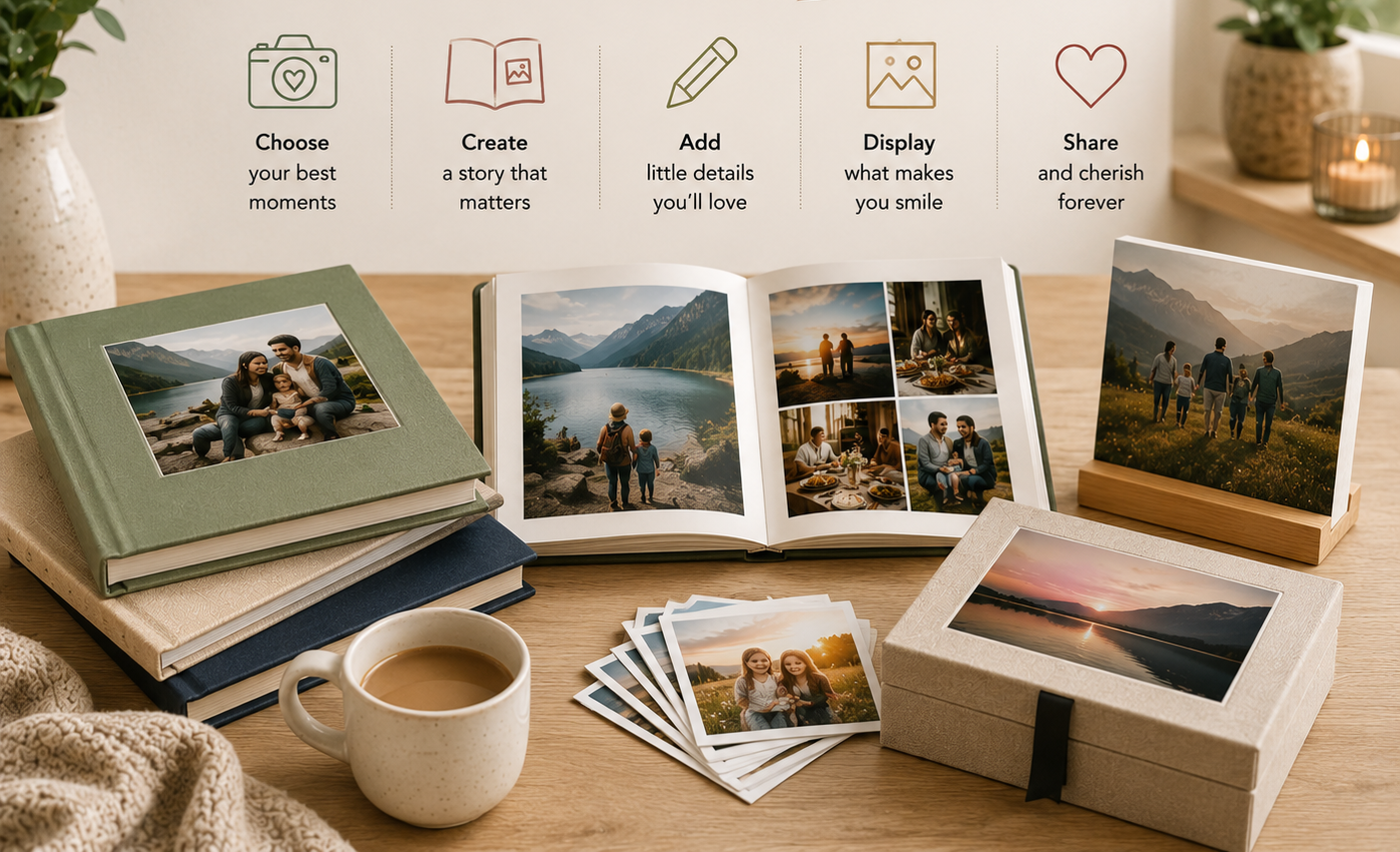
We take photographs almost every day. A family dinner, a weekend trip, a birthday celebration, a child’s funny expression, a beautiful sunset, or even a completely ordinary afternoon can become a photograph within seconds. Our phones make it incredibly easy to capture these moments, but they also make it easy to forget about them. Thousands of photographs can sit quietly in a camera roll, pushed further down every time we take another picture.
Every once in a while, though, we come across an old photograph and instantly remember everything about it. We remember where we were, who was with us, what we were doing, and sometimes even how we felt that day. That is what makes photographs so powerful. They don’t simply show us what something looked like; they can bring back an entire moment.
Turning some of those photographs into physical keepsakes is a simple way to make those memories easier to revisit. Instead of leaving your favorite images hidden in digital folders, you can bring them together in a photo book, display them around your home, or create something personal that can be shared with family and friends.
Start With the Memory, Not the Photograph
When you decide to create a keepsake, it can be tempting to immediately start scrolling through your camera roll. But with hundreds or even thousands of photographs to choose from, that can quickly become overwhelming. A better place to begin is with the memory itself.
Think about an experience that you would genuinely like to remember years from now. It could be a family vacation, a wedding, a child’s first year, a graduation, a milestone birthday, or a special trip with friends. It doesn’t necessarily have to be a major occasion either. A collection of photographs from an ordinary but particularly happy year can be just as meaningful.
Once you’ve chosen the story, start looking for photographs that help tell it. You don’t need every picture from that particular day or trip. Instead, look for photographs that capture different parts of the experience and give the collection a natural flow.
A photograph of everyone together can establish the people involved, while candid photographs can capture the little moments that made the experience memorable. A picture of the destination can show where you were, while a photograph of a meal, a funny moment, or something unexpected can bring the personality of the experience into the collection.
Choose the Photographs That Bring Back a Feeling
It is easy to assume that the best photographs are the ones with perfect lighting, beautiful composition, and everyone looking directly at the camera. But when you are creating a personal keepsake, those things aren’t necessarily what matter most.
Think about the photographs that make you pause when you see them. Maybe one is slightly blurry because everyone was laughing. Perhaps someone is looking away from the camera, or the lighting isn’t quite right. If the photograph brings back a strong memory, it may be much more valuable than a technically perfect picture.
Years from now, you probably won’t care whether the photograph was perfectly framed. You will care that it shows the people you love, the places you’ve been, or a moment you don’t want to forget.
That is why it can be helpful to choose photographs based on the story and emotion behind them rather than simply choosing the most polished images.
Give Your Photos a Story to Follow
A collection of photographs becomes much more interesting when there is a connection between the images. Instead of thinking of your keepsake as a collection of individual pictures, imagine that you’re creating a visual story.
For example, a vacation photo book could begin with the journey itself and gradually move through the different places you visited. You could include photographs of the people you travelled with, favorite meals, interesting places you discovered, and unexpected moments along the way. By the final pages, the photographs can naturally lead back to the journey home.
You can use the same idea for a family album. Perhaps you want to capture an entire year, beginning with January and moving through birthdays, holidays, vacations, school events, and everyday family moments. Or you might want to focus on one particular person and document an important stage of their life.
The structure doesn’t have to be complicated. Even a simple chronological arrangement can make a collection feel more connected.
Add Small Details That Help You Remember
Photographs can show you what happened, but small pieces of text can help explain the memory behind them. You don’t need to write long descriptions or turn your photo book into a diary. A few words can sometimes be enough.
A date, location, name, or short sentence can bring back details that might otherwise disappear with time. Something as simple as “Our first trip together” or “Sunday dinner at Grandma’s” can mean much more when you read it several years later.
You can also include funny comments, inside jokes, favorite quotes, or small details that only your family or friends would understand. Those personal touches can make the finished keepsake feel much more authentic.
The idea is not to explain every photograph. Let the pictures do most of the talking and use words only where they add something to the story.
Choose a Format That Makes Sense for Your Memories
Once you know what you want to preserve, think about how you would like to experience it. A photo book is probably the most versatile option when you have a collection of photographs that belong together. It gives you enough space to create a beginning, middle, and end while allowing you to include captions and personal details.
For a smaller collection, however, a framed print or piece of wall décor may make more sense. If you have one photograph that holds a particularly special memory, displaying it somewhere you can see it every day can be more meaningful than putting it inside an album.
Calendars are another interesting option for family photographs, travel memories, pets, or seasonal moments. Instead of looking at the same collection once in a while, you get to revisit a different photograph throughout the year.
There are also personalized cards and other photo gifts that can work particularly well when you want to create something for another person. The right format ultimately depends on the story you’re trying to preserve and how you want to experience it later.
Make the Design Personal Rather Than Perfect
Creating a photo keepsake doesn’t mean you need to become a professional designer. In fact, trying too hard to make everything perfect can sometimes take away from the personality of the photographs.
A simple layout with a large photograph can be incredibly effective. On another page, you might want several smaller images together because they capture a series of moments. You could use different layouts throughout the project rather than making every page look exactly the same.
The design can also reflect the memory itself. A travel collection might look great with a clean and simple style, while a family album could be warmer and more playful. A wedding album may call for something more elegant, while a childhood photo book could be colorful and fun.
Online photo-creation platforms can make this process much easier by providing templates, themes, layouts, and editing tools. Mixbook is one of the better options to consider for this type of project, particularly if you want to create personalized photo books, calendars, cards, or home décor without having to design everything from scratch.
The important thing is to create something that feels natural to you. It doesn’t need to look like a professionally produced magazine. It needs to feel like your story.
Don’t Try to Include Every Photograph
One of the biggest challenges when creating a photo keepsake is deciding what to leave out. You may start with hundreds of photographs and feel that every one deserves a place.
Usually, that’s not necessary.
Think of your keepsake as a collection of highlights rather than a complete archive. If you have several photographs that look almost identical, choose the one that captures the moment best. If you have dozens of pictures from the same location, pick a few that show different aspects of the experience.
This approach gives your favorite photographs more room to stand out and makes the finished project much easier to look through.
It can also help to step away from the project for a while. After choosing your first selection, come back to it later and see which photographs still feel important. Sometimes the images you initially thought were essential don’t feel quite as meaningful after you’ve had some distance from them.
Make the Project a Shared Experience
Creating a photo keepsake doesn’t have to be something you do alone. In fact, asking family members or friends to contribute can make the process even more enjoyable.
Someone else may have photographs from an event that you completely forgot about. Another person may remember the story behind a photograph that you haven’t thought about in years. You might even discover that your favorite photograph isn’t someone else’s favorite at all.
Bringing those perspectives together can create a much richer collection of memories. This can work especially well for family reunions, weddings, group vacations, milestone birthdays, or anniversaries.
The process of looking through photographs together can become part of the memory itself. You may spend more time laughing and telling stories than actually choosing pictures, and that is perfectly fine.
Turn a Collection of Photos Into a Thoughtful Gift
A personalized photo keepsake can also be a wonderful way to give someone something that feels genuinely personal. Instead of trying to find another generic gift, you can build something around memories that already mean something to both of you.
For parents or grandparents, a family photo book can bring together photographs from different generations. For friends, photographs from a shared trip can become a reminder of an experience you both enjoyed. For a partner, a collection of photographs can document important moments in your relationship.
What makes these gifts special is not necessarily the finished product itself. It is the time spent choosing the photographs and thinking about the memories behind them.
That personal effort is often what people remember.
What If You Have Too Many Photos?
If your phone contains years of photographs, the idea of organizing them can feel impossible. The trick is not to tackle everything at once.
Choose one event, one year, or one person. Once you have narrowed the project down, the number of photographs becomes much more manageable.
You can then remove duplicates, blurry images that don’t hold any particular meaning, and photographs that don’t really contribute to the story. From there, select the images that represent different moments, people, and emotions.
Many online photo platforms also offer tools that help you upload, organize, sort, and arrange photographs. These features can be especially useful when you’re working with a large collection.
The important thing is to start somewhere. You don’t have to organize your entire digital life to create one meaningful keepsake.
Let Technology Help Without Taking Away the Personal Touch
Technology has made the process of creating personalized photo products much easier than it used to be. You no longer need complicated software or professional printing equipment to create something that looks polished.
Modern platforms can help with everything from layouts and photo organization to editing and design suggestions. Some even use AI-assisted tools to help arrange photographs or create a starting point for a project.
That can save time, particularly when you’re working with a large number of images. But the personal decisions should still come from you.
You decide which memories matter. You decide which photographs belong together. You decide which captions or stories are worth including.
Technology can make the process easier, but it is the memories that give the final keepsake its meaning.
Think About What You Will Want to Remember Years From Now
One useful question to ask while creating your project is, “What will I wish I could remember about this moment ten or twenty years from now?”
That question can change the way you look at your photographs.
Instead of simply choosing the prettiest images, you start looking for the people, places, small details, and emotions that made the experience special. You may choose a photograph of your parents that you hadn’t originally considered, or an ordinary picture of your children that suddenly feels much more important.
Those are often the photographs that make a keepsake worth keeping.
You Don’t Need to Wait for a Big Occasion
There is no need to wait for a wedding, anniversary, birthday, or major milestone before creating something meaningful.
A simple collection of your favorite moments from the past year can be enough. You could document a new home, a growing family, a favorite hobby, a memorable trip, or simply the everyday moments that made the year special.
Starting with a smaller project can also make the process much easier. Once you’ve created one keepsake, you may find yourself looking at the photographs on your phone differently and noticing other collections that could become something special.
Why Physical Keepsakes Still Have a Place in a Digital World
We have never had more ways to store photographs. Cloud storage, smartphones, social media, and digital albums make it possible to keep thousands of memories within reach.
Yet there is still something different about having a physical collection.
A photo book can sit on a shelf and be picked up years later. A framed photograph can become part of your home. A personalized calendar can bring a different memory into view every month. These objects give photographs a physical presence that a digital folder simply doesn’t have.
More importantly, they encourage us to slow down.
Instead of quickly scrolling through dozens of photographs, you turn a page, look at an image, and remember the story behind it.
That simple experience is what makes physical keepsakes continue to feel special.
Final Thoughts: Give Your Memories Somewhere to Live
Your favorite memories are probably already sitting on your phone. You don’t need professional photographs, complicated software, or hundreds of images to turn them into something meaningful. Start with one story and a handful of photographs that genuinely matter to you.
Take the time to choose the images that make you smile, arrange them in a way that feels natural, and add a few personal details that will help you remember the moment later. Whether you create a photo book, calendar, framed print, personalized card, or another type of keepsake, the goal is the same: to give your memories a life beyond your camera roll.
For anyone who wants an accessible way to bring photographs together, Mixbook is a strong choice for creating personalized photo books and keepsakes, offering a range of formats and customization tools without requiring professional design experience.
But ultimately, the platform is only part of the process. What makes the finished keepsake special is the story you put into it.
Because years from now, you may not remember every photograph stored on your phone. You will remember the ones that you chose to turn into something you could hold, share, and look back on — and sometimes, those simple pages can become some of the most valuable things you own.